Dual-Goal Optimization Under Time Pressure
A Paradigm for Studying Cognitive Conflict and Response Selection
Abstract
This paper presents a game-based paradigm intended for the potential study of cognitive conflict, resource allocation, and response selection under time constraints. Within a single decision-making process, the proposed model integrates two competing objectives - numerical optimization and the formation of color patterns. According to dual-task interference theory and the Psychological Refractory Period (PRP) effect, such tasks may create a bottleneck at the response selection stage, and may also lead to sequential processing, strategy simplification, and goal prioritization. This game-based paradigm may be considered a controlled environment for studying executive control, adaptive decision-making, and cognitive limitations in integrating complex demands.
Introduction
Human decision-making rarely reduces to optimizing a single objective. In many real-world situations, individuals are required to simultaneously consider multiple constraints and goals under limited temporal and cognitive resources. A significant portion of research in cognitive psychology has traditionally examined tasks either in isolation or as parallel but independent processes (dual-task paradigms).
Classic studies of dual-task interference show that performance deteriorates when individuals process multiple tasks simultaneously (Pashler, 1994). One of the most robust effects in this area is the Psychological Refractory Period (PRP), demonstrating that response selection is limited by a central processing bottleneck.
The Dual-Task Anadidax test presents a paradigm that models a situation in which two competing goals must be integrated into a single decision-making process.
Theoretical Background
Dual-Task Interference and PRP
Dual-task research indicates that cognitive processing is limited by a central bottleneck. In PRP paradigms, when two stimuli requiring separate responses are presented with minimal temporal delay, the second response is delayed (Pashler, 1994). This delay reflects limitations at the response selection stage: while perception and motor preparation may occur in parallel, response selection is carried out predominantly sequentially.
Executive Control and Goal Conflict
Integrating multiple goals within a single decision requires the involvement of executive functions, including updating, inhibition, and task switching (Miyake et al., 2000). When conflict arises between goals, the cognitive control system must resolve competition and determine action priorities.
According to conflict monitoring theories, the brain detects competing demands and reallocates control resources (Botvinick et al., 2001). In multitask situations, this often leads to the dominance of one goal over another, described as “goal shielding.”
Key point. Neuroscientific research suggests that processes often described as multitasking are more accurately interpreted as rapid switching between tasks rather than true parallel processing (Miller & Cohen, 2001).
Game Paradigm
The proposed task aims to model a situation approximating real-world decision-making conditions, in which a conflict of goals arises at the response selection stage under time constraints.
Task Structure
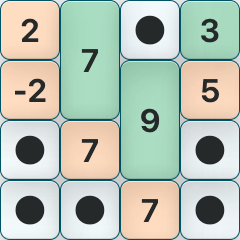
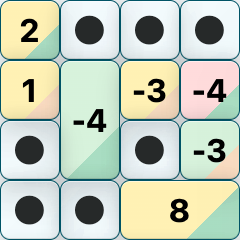
The task is performed on a grid-based field consisting of positions with predefined coefficients. The participant is provided with a set of elements, each of which has:
- a numerical value
- a color
The participant’s task is to place these elements on the field while simultaneously optimizing two objectives.
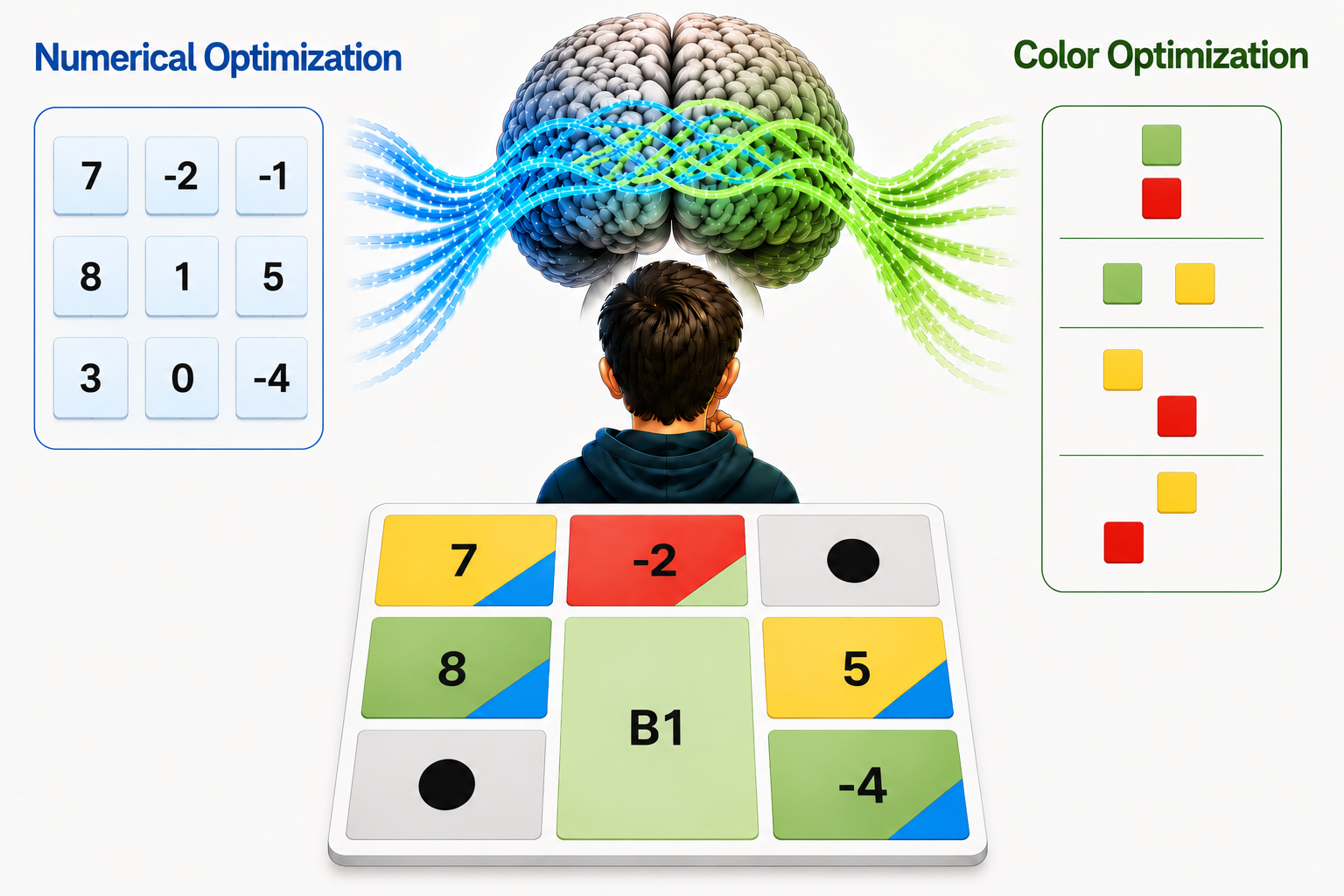
Objective 1: Numerical Optimization
Each placement contributes to the overall numerical score, depending on:
- the value of the element
- its position on the field
- the corresponding coefficients
The goal is to maximize the numerical score.
Objective 2: Color Pattern Optimization
At the same time, the participant must form predefined color combinations on the field (for example sequences of three elements of the same color arranged horizontally or vertically). A separate metric is formed—the color score, reflecting the number of correctly constructed color patterns.
Final Metric
The overall result is defined as the average of:
- the percentage of the maximum achievable numerical score
- the percentage of completed color combinations
Thus, ignoring any of the objectives leads to a decrease in the final result. The main indicators are the numerical score, the color score, and the degree of their balance, reflecting the participant’s ability to distribute attention between competing goals. All actions are performed under time constraints, which increases cognitive load and limits the possibility of exhaustive search.
Cognitive Mechanisms
The task requires the participant to:
- evaluate the numerical consequences of actions
- track color configurations
- compare alternatives
- select a specific action
All these processes converge at the response selection stage. Due to limitations of the cognitive system, these processes cannot be fully executed in parallel. Instead, switching occurs between different aspects of the task, which may lead to effects similar to PRP.
Study
The proposed paradigm may be used to model the decision-making process under competing goals. In the future, an empirical study may be conducted to evaluate dual-goal optimization in a sample of participants. The proposed paradigm may be used to model the decision-making process under competing goals. In the future, an empirical study may be conducted to evaluate dual-goal optimization in a sample of participants.
- Baddeley, A. D., & Hitch, G. (1974). Working memory. Psychology of Learning and Motivation, 8, 47–89.
- Botvinick, M. M., Braver, T. S., Barch, D. M., Carter, C. S., & Cohen, J. D. (2001). Conflict monitoring and cognitive control. Psychological Review, 108(3), 624–652. https://doi.org/10.1037/0033-295X.108.3.624
- Kahneman, D. (1973). Attention and effort. Prentice-Hall.
- Miyake, A., Friedman, N. P., Emerson, M. J., Witzki, A. H., Howerter, A., & Wager, T. D. (2000). The unity and diversity of executive functions. Cognitive Psychology, 41(1), 49–100. https://doi.org/10.1006/cogp.1999.0734
- Pashler, H. (1994). Dual-task interference in simple tasks: Data and theory. Psychological Bulletin, 116(2), 220–244. https://doi.org/10.1037/0033-2909.116.2.220
- Tombu, M., & Jolicœur, P. (2003). A central capacity sharing model of dual-task performance. Journal of Experimental Psychology: Human Perception and Performance, 29(1), 3–18. https://doi.org/10.1037/0096-1523.29.1.3