How Animals Helped Us Understand the Nature of Number
A Historical Review of Numerical Cognition Research
Abstract
For much of the history of psychology, numerical competence was treated as a uniquely human achievement grounded in language, schooling, and symbolic culture. Comparative research gradually challenged this assumption. Studies involving horses, birds, non-human primates, fish, insects, and other species demonstrated that animals can discriminate quantities, compare sets, preserve ordinal relations, and in some cases associate symbolic labels with numerosities. These findings did not show that animals possess arithmetic in the human sense. Instead, they revealed a set of evolutionarily older mechanisms for representing quantity. This article reviews several landmark episodes in the development of comparative numerical cognition, from the methodological lessons of Clever Hans to research on symbolic number use in chimpanzees, numerical ordering in monkeys, numerosity-selective neurons, and quantity processing in non-primate species. The history of this field illustrates how animal research helped separate counting from estimation, number from non-numerical perceptual cues, and symbolic mathematics from more basicrepresentations of magnitude.
Introduction
The ability to use numbers is often presented as a defining feature of human cognition. Formal arithmetic depends on symbolic notation, explicit rules, language, education, and cultural transmission. Yet many decisions faced by animals are inherently quantitative. An individual may need to choose the larger food patch, assess whether its group outnumbers a rival group, monitor the number of offspring, or remember how many landmarks have been passed during navigation.
Comparative studies therefore ask a more fundamental question than whether animals can perform arithmetic: what forms of numerical representation are possible in the absence of human language and schooling? Over the twentieth century, the answer changed substantially. Early demonstrations were frequently vulnerable to uncontrolled cues and anthropomorphic interpretation. Later experiments introduced stricter controls, novel stimuli, transfer tests, and neurophysiological recording. Together, these methods revealed that sensitivity to quantity is widespread, although the underlying capacities vary considerably across species and tasks.
Clever Hans and the Problem of Unintended Cues
The modern history of animal numerical cognition is often traced to the case of Clever Hans, a horse whose owner claimed that he could solve arithmetic problems and communicate answers by tapping his hoof. Public demonstrations appeared convincing: the horse seemed able to add, subtract, multiply, and even answer questions involving calendars.
Oskar Pfungst's investigations showed, however, that Hans was not calculating. Instead, the horse responded to subtle, involuntary changes in the posture and facial expression of human observers. Performance deteriorated when the questioner did not know the answer or when Hans could not see the relevant person. The episode became a foundational methodological lesson. Apparent numerical competence could not be accepted unless experiments eliminated inadvertent cueing, experimenter expectations, and simple perceptual shortcuts.
The importance of the Clever Hans effect extends beyond comparative psychology. It established the need for blinded procedures, automated stimulus presentation, and controls designed to exclude alternative explanations. In this sense, a failed claim about animal arithmetic contributed directly to the development of more rigorous experimental science.
Early Systematic Studies of Quantity
Following the Clever Hans episode, researchers approached claims of animal counting with greater caution. Otto Koehler's work with birds during the mid-twentieth century was among the first sustained programs to investigate quantitative behavior under controlled conditions. Jackdaws, ravens, parrots, and other birds were trained to perform a specified number of actions or to respond to sets containing a particular number of items.
These experiments suggested that some birds could discriminate small numerosities and reproduce limited numbers of responses. However, interpretation remained difficult. Repeated training could produce highly specific stimulus-response associations, and animals might rely on duration, spatial extent, density, cumulative surface area, or other correlated variables. The central methodological problem was therefore not merely to show successful performance, but to determine whether quantity itself controlled behavior.
Defining Numerical Competence
By the 1980s, the literature contained a large number of apparently positive findings, but the term numerical competence was used inconsistently. Davis and Pérusse's influential 1988 review addressed this problem directly. They argued that the field needed clearer definitions, stronger controls, and a distinction between different levels of quantitative behavior.
At the lowest level, an animal may simply respond to more versus less. At a more advanced level, it may preserve ordinal relations, match a set to a symbol, or generalize a numerical rule to novel stimuli. These forms of performance should not be treated as equivalent. The review also emphasized that non-numerical dimensions of stimuli must be controlled systematically. Total area, element size, contour length, density, brightness, spatial arrangement, and presentation time can all correlate with numerosity and thereby support successful choices without a representation of number.
This methodological framework helped shape subsequent research. Rather than asking only whether animals could succeed, researchers increasingly asked what information was necessary and sufficient for success, whether learning transferred to new conditions, and whether performance exhibited characteristic signatures such as ratio dependence.
Chimpanzee Ai and Symbolic Number Use
A major advance came from Tetsuro Matsuzawa's work with the chimpanzee Ai. In experiments beginning in the 1980s, Ai learned to associate Arabic numerals with corresponding quantities. She could select a numeral that matched a displayed set and later acquired ordered relations among numerals.
The significance of these studies lay not in showing human-like arithmetic, but in demonstrating that a non-human primate could learn a stable relation between an arbitrary visual symbol and numerosity. Symbolic competence is more demanding than simply choosing the larger of two sets because the animal must map a conventional sign onto an abstract quantitative property that can be instantiated by many different visual arrays.
Subsequent work within the same research program examined enumeration, memory, ordering, and the boundary between rapid processing of small sets and slower processing of larger sets. These studies helped establish chimpanzees as an important comparative model for investigating which components of numerical cognition depend on language and which do not.
Ordinality and Abstract Numerosity in Monkeys
Research by Elizabeth Brannon and Herbert Terrace provided another landmark result. Rhesus monkeys were trained to order visual arrays according to numerosity. Crucially, the animals could transfer the learned ordering rule to novel stimuli, suggesting that they were not memorizing particular pictures.
This ability to preserve the relation smaller than or larger than across changes in stimulus appearance supported the idea that monkeys could represent ordinal numerical relations. Later studies showed that performance was often ratio-dependent: discriminations were easier when the numerical ratio between two sets was large and harder when the ratio approached one. This pattern is characteristic of approximate magnitude representations and is consistent with Weber's law.
Such findings were central to the development of the Approximate Number System framework. They indicated that non-human primates possess an approximate, noisy representation of numerosity whose precision depends on proportional rather than absolute difference.
From Behavior to Neurons
Until the beginning of the twenty-first century, evidence for animal numerical cognition was primarily behavioral. A decisive step came from single-cell recording studies in monkeys by Andreas Nieder and colleagues. While animals performed numerical matching tasks, researchers recorded the activity of individual neurons in prefrontal and parietal cortex.
Some neurons showed maximal activity for a preferred numerosity. One neuron might respond most strongly to two items, another to four, and another to a larger set. Responses generally declined as the presented numerosity moved farther from the preferred value. This tuning was approximate rather than perfectly categorical, and its width increased for larger numerosities, a pattern compatible with compressed or ratio-dependent coding.
These results provided direct neurophysiological evidence that numerosity is represented by specialized neuronal populations. Importantly, the neurons were not simply detectors for one visual pattern, because experiments varied the size, position, and arrangement of items. Later studies also investigated cross-modal and abstract numerical coding, strengthening the view that the brain can represent number independently of a single sensory format.
Beyond Primates
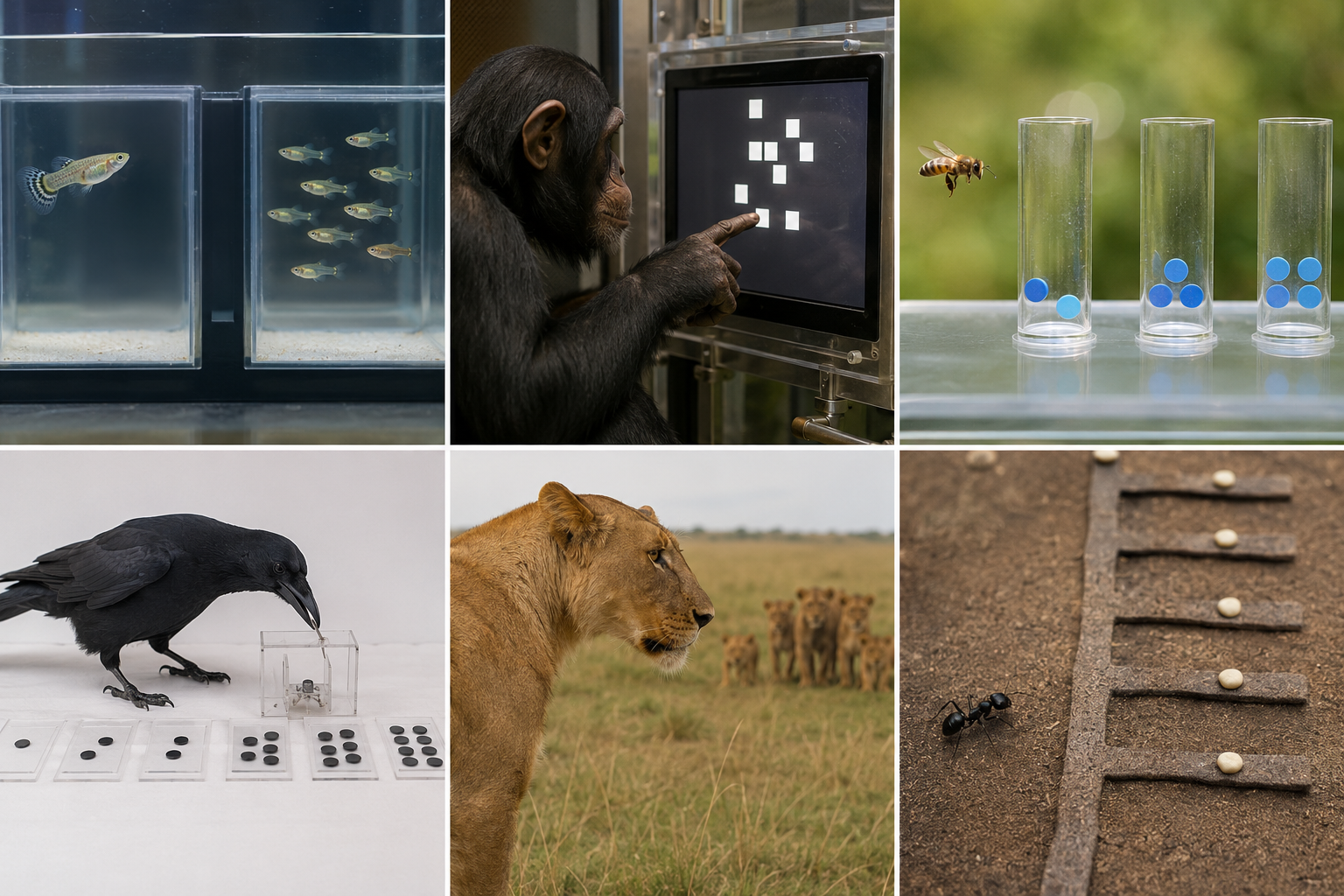
Evidence for quantitative processing is not limited to primates. African grey parrots, especially Irene Pepperberg's subject Alex, learned to use vocal labels for small numerosities and to answer questions about how many objects of a specified type were present. Fish such as guppies often prefer larger shoals, and their discrimination performance frequently depends on numerical ratio. This suggests that approximate quantity can guide ecologically relevant choices such as predator avoidance and social affiliation.
Studies of lions have shown that groups can use the number of vocalizations to assess the likely size of a rival coalition and adjust their behavior accordingly. Honeybees have been trained to distinguish numerosities and, in some experiments, to apply learned relational rules resembling plus one or minus one. Such results are striking because they show that sophisticated-looking quantitative behavior does not require a large vertebrate brain.
Claims involving ants, reptiles, and other taxa remain especially interesting but should be interpreted cautiously. In some cases, the evidence may support sequence coding, distance estimation, landmark use, or learned choice rules rather than counting in a strict sense. Comparative research is most informative when it identifies the precise mechanism required by a task instead of grouping all successful performance under the single label of counting.

What Animal Research Changed
Animal studies transformed the study of number in several ways. First, they demonstrated that numerical sensitivity does not depend entirely on language. Second, they forced researchers to distinguish exact symbolic number from approximate magnitude. Third, they revealed that quantitative behavior is constrained by perceptual and cognitive factors, including ratio, set size, attention, memory, and stimulus organization. Finally, neurophysiological work showed that numerosity can be encoded by specialized neuronal populations.
These findings support a layered view of numerical cognition. At one level, organisms possess approximate systems for comparing quantities. At another, some species can track a small number of individual objects with relatively high precision. Through training, a limited number of animals can also acquire symbolic correspondences between signs and quantities. Human mathematics builds upon, but is not reducible to, these more basic systems.
Conclusion
Over the past century, animal research has fundamentally altered scientific accounts of number. The field began with an instructive error: Clever Hans appeared to calculate but was actually reading human behavior. The methodological safeguards developed in response made later findings far more persuasive.
Controlled studies subsequently showed that a wide range of animals can discriminate quantities, preserve numerical order, and make decisions on the basis of relative numerosity. Work with chimpanzees and monkeys demonstrated that non-human primates can acquire symbolic numerical associations and represent ordinal relations. Neurophysiological research then identified neurons tuned to preferred numerosities, providing a direct biological basis for approximate numerical representation.
These results do not imply that animals possess arithmetic in the human cultural sense. Rather, they show that formal mathematics is built upon evolutionarily older systems for representing quantity. By studying what animals can and cannot do, comparative cognition has clarified the boundary between perception, estimation, counting, and symbolic thought. In this way, animals did more than reveal unexpected cognitive capacities: they helped science define what a number is as a psychological and neural object.
- Pfungst, O. (1911). Clever Hans (The Horse of Mr. von Osten): A Contribution to Experimental Animal and Human Psychology. Henry Holt.
- Koehler, O. (1951). The ability of birds to count. Bulletin of Animal Behaviour, 9, 41-45.
- Davis, H., & Pérusse, R. (1988). Numerical competence in animals: Definitional issues, current evidence, and a new research agenda. Behavioral and Brain Sciences, 11(4), 561-579.
- Matsuzawa, T. (1985). Use of numbers by a chimpanzee. Nature, 315, 57-59
- Brannon, E. M., & Terrace, H. S. (1998). Ordering of numerosities by monkeys. Science, 282(5389), 746-749.
- HTomonaga, M., & Matsuzawa, T. (2002). Enumeration of briefly presented items by the chimpanzee and humans. Animal Learning & Behavior, 30(2), 143-157.
- Nieder, A., Freedman, D. J., & Miller, E. K. (2002). Representation of the quantity of visual items in the primate prefrontal cortex. Science, 297(5587), 1708-1711.
- Nieder, A., & Miller, E. K. (2004). A parieto-frontal network for visual numerical information in the monkey. Proceedings of the National Academy of Sciences, 101(19), 7457-7462.
- Pepperberg, I. M. (2006). Grey parrot numerical competence: A review. Animal Cognition, 9, 377-391.
- Feigenson, L., Dehaene, S., & Spelke, E. S. (2004). Core systems of number. Trends in Cognitive Sciences, 8(7), 307-314.
- Nieder, A. (2016). The neuronal code for number. Nature Reviews Neuroscience, 17(6), 366-382.